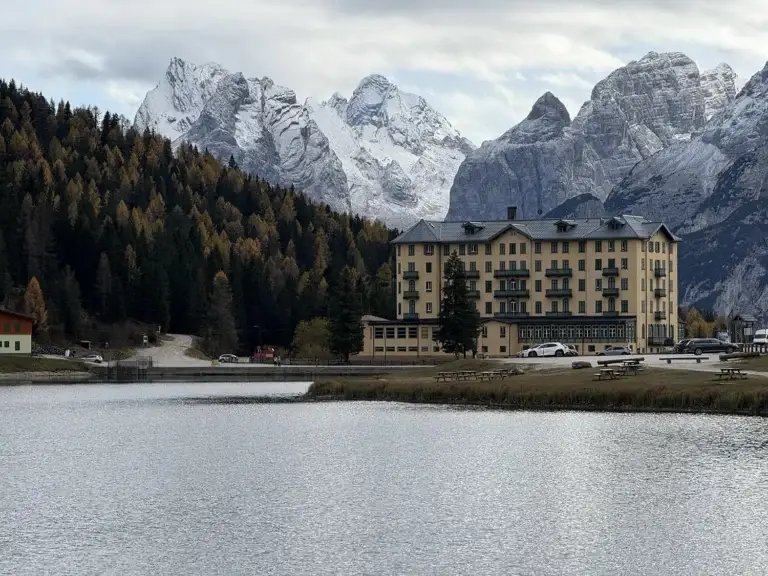
Every day I see people arriving, walking around the lake in twenty minutes. They get out of the car, follow the trail while looking at their phone, take three photos and leave, convinced they’ve “done” Misurina. Then there are those who take two hours for the same route, sit on the benches, watch how the light changes on Mount Cristallo, and maybe come back the next day because they’ve realized that this is a place worth seeing slowly.
After twenty years here, let me tell you something: the walk around Lake Misurina is technically the simplest route you can take in the area. But simple doesn’t mean trivial. It depends on how you approach it.
The trail: what you need to know beforehand
The path surrounding the lake is 2.6 kilometers long. At a normal pace, it takes about 45 minutes, maybe an hour if you stop to enjoy the views. There’s virtually no elevation gain – you’re already at 1,754 meters, so the only climb you did was driving here. The trail is marked, wide, and has benches every hundred or two hundred meters.
Everyone will tell you it’s “suitable for everyone.” And in theory, that’s true. But let me clarify, because I’ve seen families with strollers swearing at the natural trail surface and tourists in flip-flops slipping on wet stones.
The north side of the lake, facing the Tre Cime, has a well-compacted surface. Strollers? Possible. The east side, toward the Cadini mountains, has sections with roots, exposed stones, and puddles after rain. With hiking shoes, no problem. With beach flip-flops, yes. The west side, under Mount Cristallo, is the most scenic and also the busiest. The south side, toward Auronzo, is the quietest and usually the least crowded.
If you have small children who walk on their own, the loop is suitable from age five and up. Before that, a child carrier is better, especially if you want to complete the full loop without stopping every ten minutes. It’s not a matter of difficulty, but of interest: a three-year-old gets bored after five hundred meters of flat trail.
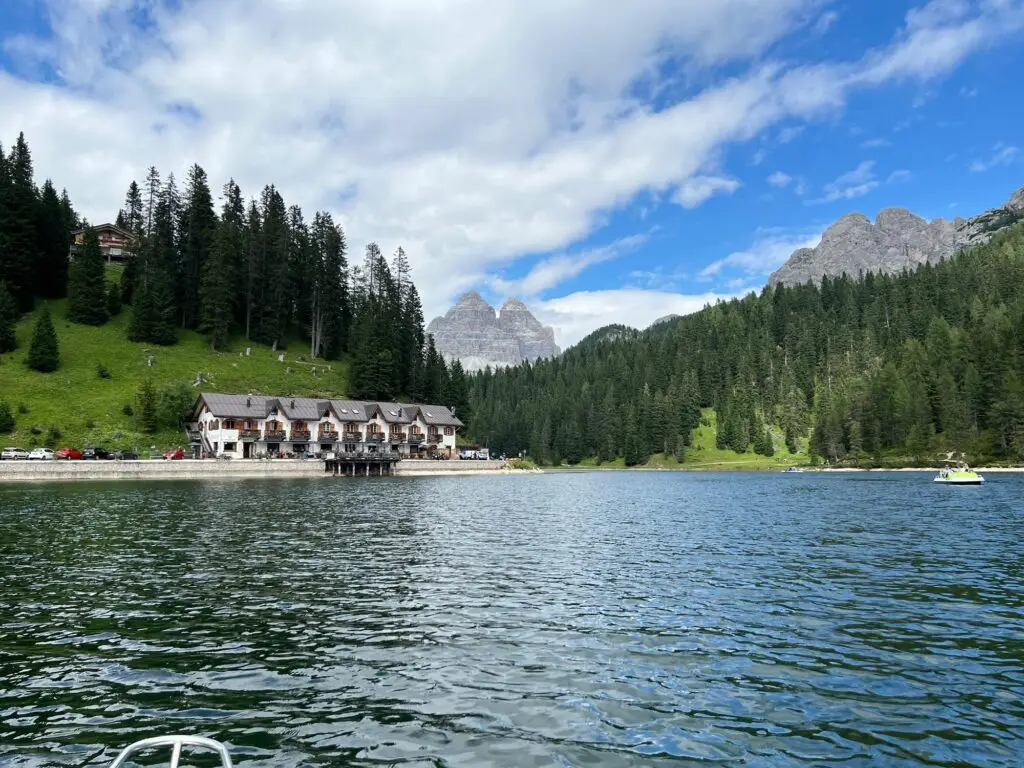
When to walk the loop (and when not to)
This is where people get it wrong. Most visitors arrive between ten and two, the worst time to walk around the lake. Hot, flat light, too many people, full parking lots. Then they ask me why their photos don’t look like the ones on Instagram.
The best time is early morning, between six and eight. The lake is a mirror, the air is crisp, and the sun lights up the Tre Cime from the side, creating beautiful contrasts. There are very few people, and you can walk in peace. The downside? You have to wake up early, and in the mountains mornings are cold even in summer. Bring a jacket.
Late afternoon, from five onwards, is also good. The light softens, the tourist buses have left, and the lake becomes enjoyable again. Sunset here isn’t as dramatic as the one at the Tre Cime, but it has its own charm, especially in autumn when the sun sets behind the Cristallo.
At noon, with the sun overhead, reflections disappear and the mountains lose definition. Photos come out flat. If you arrive at that time, no problem—take the walk anyway, but know it’s not ideal.
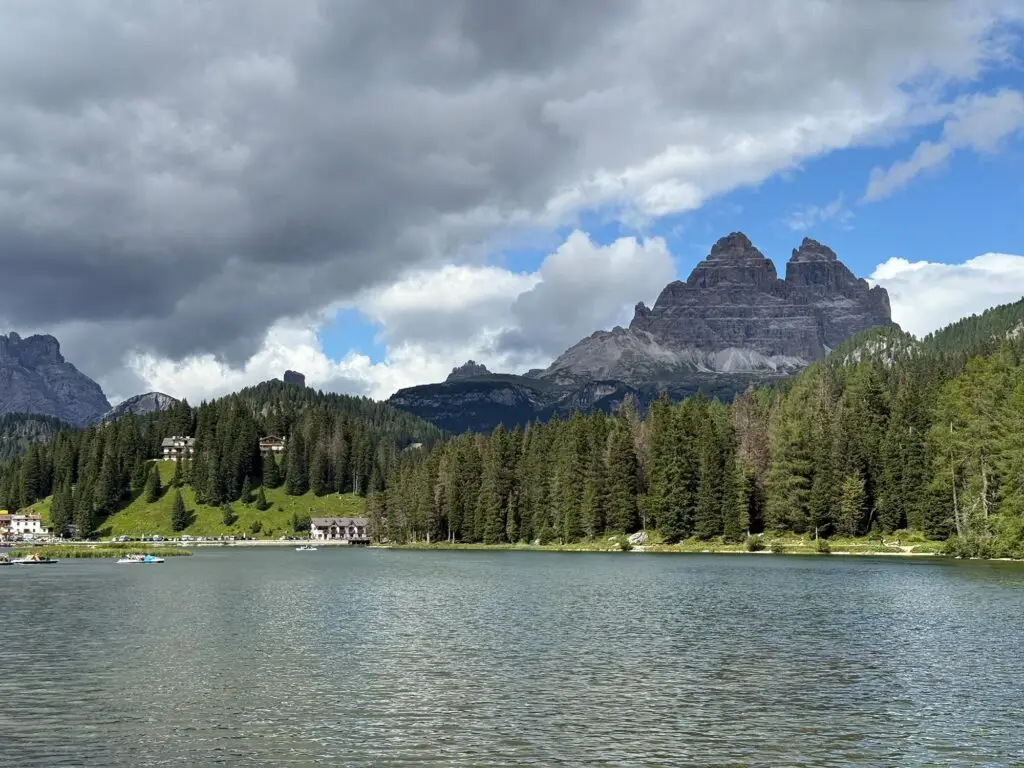
What to look at while you walk
The best part of the walk around the lake is that every side offers a different perspective. It’s not just a circular path with an unchanging landscape.
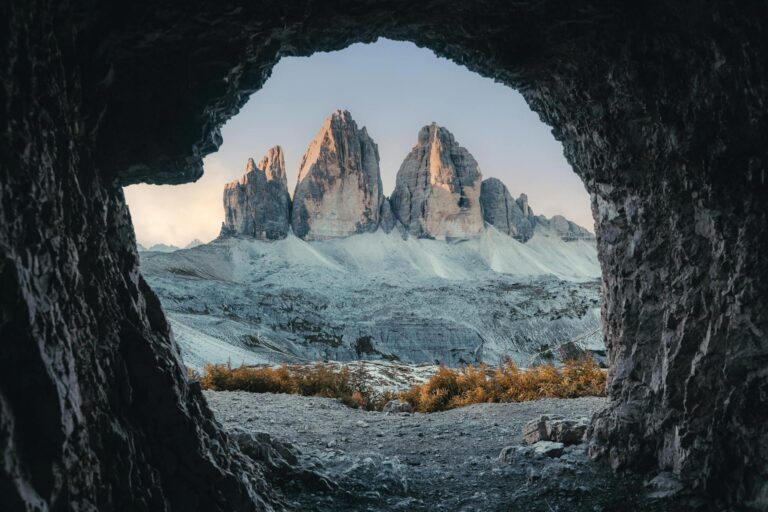
North side: The classic view of the Tre Cime di Lavaredo. Here you’ll find the most popular photo spots, with benches positioned in all the right places. The Tre Cime look close when the air is clear. If the wind blows from the north, the lake ripples and reflections disappear. If it’s calm, the mirror effect is perfect. You can’t predict it—it’s luck.
East side: Facing the Cadini di Misurina, vertical rock formations like stone fingers. Less iconic than the Tre Cime, but equally striking. The trail for the Alberto Bonacossa via ferrata starts here, climbing up toward the Cadini. If you see people with helmets and harnesses, they’re heading that way.
West side: Mount Cristallo dominates the landscape. A massive wall that stays in shade until late afternoon. The trail here is the widest and passes near some historic structures, including old boathouses. The view opens up more. It’s the side where I stop most often.
South side: Facing the Puster Valley and the valley descending toward Auronzo di Cadore. Less spectacular, but more intimate. This is where you find real quiet, especially at midday when everyone is on the other side.
Seasons change everything
I’ve walked this loop hundreds of times, and I can guarantee the lake changes completely depending on the season.
Summer (June–August): The busiest period. The water is still cold, but some people swim anyway even though swimming is not allowed. The meadows are green, the larches still dark. The trail is dry and compact. The only issue is the crowd: on July and August weekends you can find lines of people. If you visit in this period, aim for sunrise or late afternoon.
Autumn (September–October): For me, the best moment. At the end of September the larches turn golden. The air is cooler, days shorter, but the light is incredible. You might find low fog rising from the valley, or crystal-clear days when you can see the Austrian Alps. Tourists drop dramatically after mid-September. The trail can be wet from early autumn rain.
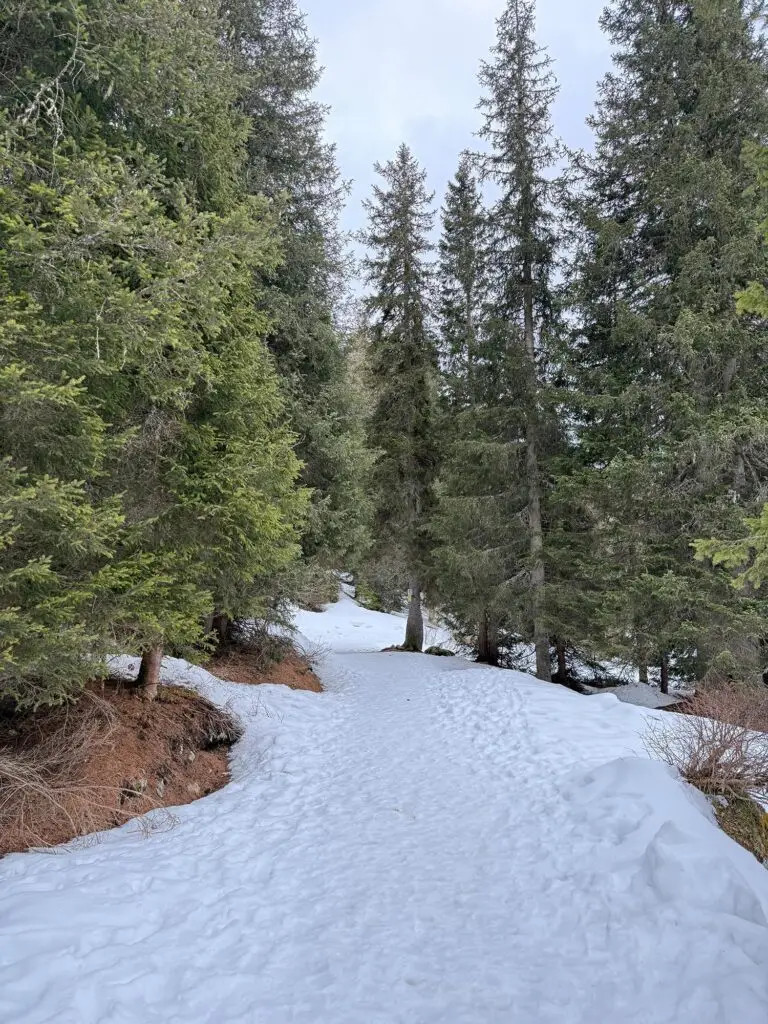
Winter (December–March): The lake freezes completely. The walk becomes a snowy track, requiring winter boots or snowshoes. The landscape turns white, and the silence is absolute. Some years they organize horse-polo on the ice, a unique sight. But winter requires preparation: temperatures below zero, cutting wind, visibility dropping to nothing if fog comes in. Not for everyone.
Spring (April–May): The most unpredictable season. You may still find snow on the trail in April, or sunny days in May with the first flowers. The lake thaws slowly, and the water stays murky for a few weeks. It’s the least crowded period—great if you seek solitude. Weather is unstable, and it can rain suddenly even with a clear sky.
What no one tells you
There are practical details you learn only by living here, and no tourist guide mentions them.
The trail is not lit. If you plan to walk at sunset, calculate the time carefully because when the sun drops behind the mountains it gets dark in ten minutes. Always carry a flashlight, even in summer.
There are no water fountains along the trail. The only drinking point is near the parking areas. If it’s July and hot, bring a full bottle.
Public restrooms are only in the main parking area. Nothing along the path. Keep it in mind if you have children. Don’t litter; animals don’t, and neither should you.
After heavy rain, the trail can get muddy in places. If you walked through a storm and think you’ll be fine with clean shoes, think again.
In spring and autumn there may be fallen branches or small landslides. They are usually cleared quickly, but sometimes you have to take small detours.
How much time you really need
If you ask me how long the loop takes, the honest answer is: it depends on what you want to do.
You can do it in thirty minutes at a fast pace without stopping. I’ve seen it many times. But it’s like running past the Mona Lisa at the Louvre just to say you’ve seen it.
You can do it in forty-five minutes at a normal pace, stopping for photos. That’s what most people do, and it’s a reasonable time.
Or you can take two hours, sitting on benches, watching the light shift, waiting for the wind to stop so reflections appear, talking to a local walking their dog. And that’s the right way to understand this place.
My advice? Plan for at least an hour and a half. Not to walk—to look. If you’re in a rush, choose another place.
Walking the loop with children
Many families ask me if the trail is suitable for children. The short answer is yes, but with some caveats.
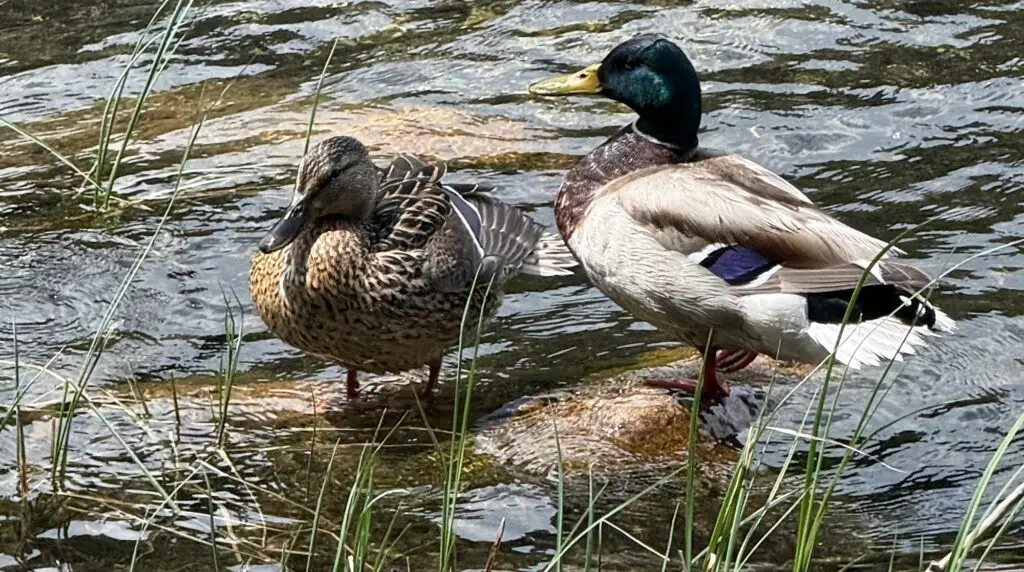
If your kids are five or older and used to walking, it’s perfect. The trail is safe, with no exposed or dangerous points, and the distance is manageable. Bring snacks and stop often, turning the walk into a game: who spots the Tre Cime first, who counts the most benches, who finds animal tracks, who sees more ducks. That was my favorite game—along with taking pictures of ALL of them.
With younger children, you need some organization. A child carrier is better than a stroller, especially on the east side. If you use a stroller, expect some uneven areas.
The real challenge with children is keeping them interested. A forty-five-minute loop can feel endless to a four-year-old. You need creativity: tell the legend of Misurina, stop to look at the fish in the water, bring binoculars to observe the mountains. Turn the walk into an adventure, not a forced march.
Alternatives to the classic loop
If you’ve already done the full loop and want something different, there are a few options.
You can stop halfway and take the trail to Lake Antorno, twenty minutes on foot to the south. It’s smaller, less crowded, and offers a different view of the mountains. I often go there when Misurina is too busy.
You can combine the loop with a hike up Monte Piana, though that’s a half-day commitment and requires some fitness. But if you have time and energy, it’s worth it.
Or you can simply choose a bench on your favorite side and stay there. Watch the lake, the mountains, the people passing by. No rush.
You can also go behind the Miralago Hotel and walk the elevated trail, which eventually reaches the Col de Varda cable car, with fewer people around.
What to bring with you
Light backpack, but with:
- Windproof jacket, even in summer (weather changes quickly here)
- Sunscreen and sunglasses (UV rays are stronger at altitude)
- Water bottle
- Snacks (bars, nuts)
- Camera or charged phone
- Closed shoes with good grip, not flip-flops
If you come in winter, add:
- Layered clothing
- Gloves and hat
- Gaiters if there’s fresh snow
- Trekking poles for balance
You don’t need anything else. It’s not a difficult hike, but it’s still the mountains. And in the mountains, it’s always better to have one thing too many than one too few.
The right moment
If you ask me when the best moment is to walk around Lake Misurina, it depends on what you’re looking for.
If you want the perfect postcard with calm water and reflections, aim for September or early October at sunrise. Your chances of ideal conditions are higher.
If you want peace without crowds, come in May or late autumn after mid-October. Or in winter, if the cold doesn’t scare you.
If you’re traveling with children and want mild temperatures, late June or early July—avoid August.
But the truth is that every season has its charm if you know what to expect. I’ve seen the lake look incredible at minus ten in January, and dull in August under the midday sun with two hundred people on the trail. It’s not just the season—it’s also luck. And the mindset you arrive with.
Last thing
The walk around Lake Misurina is not an extreme experience. It’s not an achievement. It’s a walk of forty-five minutes that anyone can do. But it’s also one of the few remaining places where you can truly stop, look, and breathe without anyone telling you what to feel or what to photograph.
Do it slowly. Sit on a bench and wait for the wind to fall so you can see the reflections. Watch how the light changes on the Cristallo every ten minutes. Talk to people you meet on the trail. Walk in silence instead of listening to music.
You can see the Tre Cime from afar, but hiking there takes another three hours. The Cadini are on your left, but climbing them requires gear. The Cristallo is in front of you, but climbing it is another story. Here, by the lake, you can stay in the middle of all this without having to prove anything. It’s a rare privilege, and many don’t notice it.
I walk here whenever I can, and I still find new details. It depends on how willing you are to look.
Thank you, Grandparents. Thank you, Misurina.